You have to spend time out there. There’s no way to shortcut it. You can’t let it sit there indoors within your mind sized box. You have to give yourself to it fully and let the compass spin wild. You have to walk the land to understand the way land is shaped. If you are never on a river, or in a lake, in a wilderness way, you won’t know why the hills are where they are. Everything you see is telling you about what already happened. But you have to slow down enough to listen.
I have spent a lot of time in the last two weeks with the Mississippi River. Along the Iowa side. I can’t explain my connection to the land or how I know things without knowing them. When I first spotted the ridge far off the right as I headed south I thought…no, it can’t be. But it ran for miles. How wide could an older version of this river have been? I headed towards the ridge, which technically was an ancient river bluff…it was miles and miles away from the Mississippi River. Only in 2026 I am looking at something so changed that it’s nearly impossible to accept that the river has meandered that far from its present course. But I swear I could see the water right up against the rocks, the way it was however many thousands of years ago. The ancient peoples here, between 400 BC and 400 AD built mounds. Nearly all of them right along waterways. Most of the major river systems in what is now called Iowa had conical and linear mounds from this culture. And then some in the shapes of creatures as at Effigy Mounds.
Today I spent time at Malchow Mounds. It’s 3.5 miles from the River and up on a bluff that at one time was just above the river. I climbed the steep hill to the top from the flat valley below marveling that the might river once saw fit to have been all the way over here. And once on the top, among the mounds, I kept imagining what it was like to have the water just there below the hill. And what was it like when it went away towards the east. How many times has the River meandered?
In the image below I have drawn a measurement line to indicate the flat valley extent from bluff to bluff on each sides of the river at this exact point. This gives the river about 10 miles of meander space in which to change course over the ages.
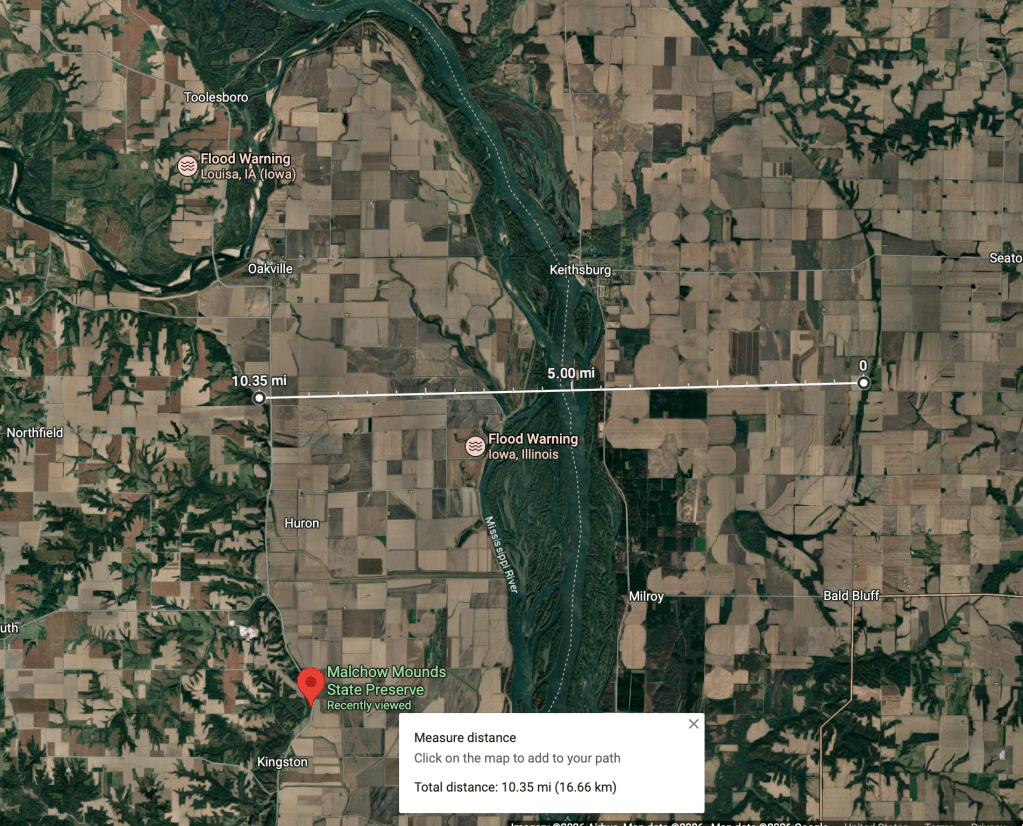
You can see on the east and west sides the green lines the run north and south. These are ancient river bluffs.
Here below is an example of the way the river meanders. Unfortunately these famous “Fisk” maps only exist for the lower Mississippi River Valley. Man…I sure wish he had made them for the Upper Valley where Iowa is. But take a look at these meanders. Each color represents a different course that the Mississippi has taken over time.
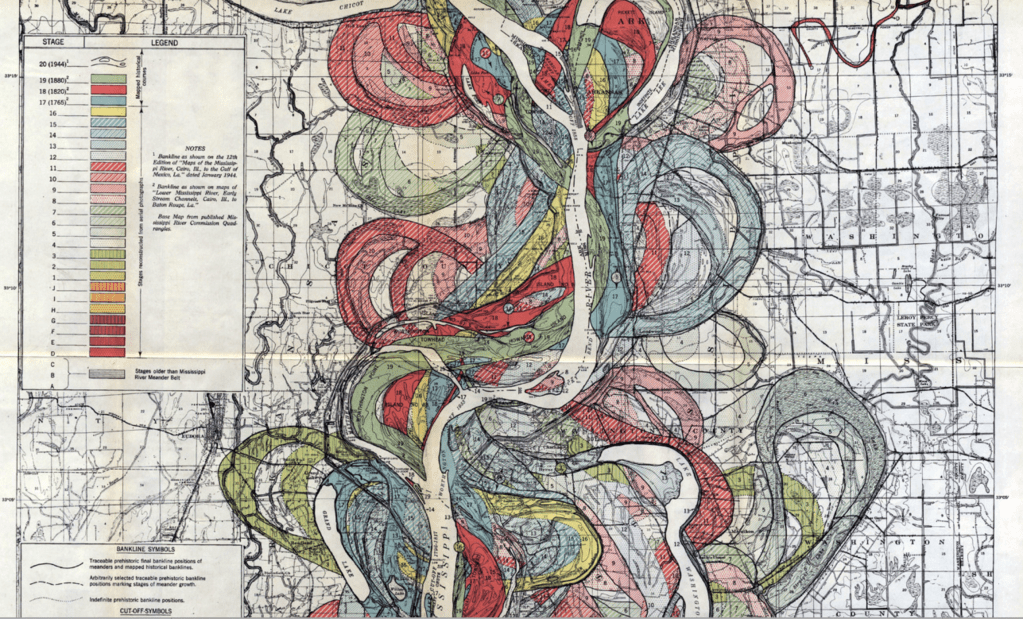
This is the Mississippi River along the Louisiana and Arkansas border. If you draw a straight line from Eudora on the West to the far East meander…you have a meander range of 17 miles.
I sat up there on the sides of the Malchow Mounds thinking about time. The river. The stars. The people that walked the earth before me. Deep time to when the river didn’t exist and the land here was covered with a shallow sea. I thought about meteors that left craters, like the one in Decorah. It’s rare that you get to be alongside something as enduring as a river like the Mississippi. And to view it while sitting in the midst of human made constructs that have somehow survived since about 400 BC…it’s all really humbling. It’s also really healing. If you get caught up solely in what is happening right now, in the madness of human affairs only, you literally suffer from the loss of the long view. It’s a paradox though. When we view things like cancer in Iowa, the loss of the native land surface from 97% of what is now called Iowa due to human will for commerce…through the lens of time, then we should be knocked over by how much damage modernists have done. The technology and ignorance for consequences that we carry are literally killing us now. And on the other side of the paradox, the amount of time that modernists have had their way with the land and environment is nothing. It’s barely a blip. When I sat on the new spring grass next to the Malchow Mounds as the chill April wind gusted…and as I fidgeted with 3 different cameras filming for the movie about Iowa…I kept telling myself to slow down. Just slow it down. What does it even mean to be in a hurry when in the presence of so many larger forces. I am just a small thing, trying to make sense out of a big story. And I never will tell the whole story. No one can. I can only be privy to a particular way of looking at history. But what I am certain of, is that with this movie, a deep history of how the land has been shaped, even before settlers came, is key to understanding our present conditions. It’s not what I expected to be doing. But it’s where the land has led me and so there it is. #TheIowaPrairieDocumentaryProject


I love this piece. I recently discovered Magnolia trees are about 100 million years old, living fossils. I then purchased my third magnolia tree. It’s astounding that ferns are about 300 million years old, I plant those too. I love getting that big zoom out perspective.
LikeLike
Thanks Ruth! Honestly I wasn’t sure anyone was reading my posts here any longer lol.
LikeLike