You know what I like about me? I am humble. No..really…I swear I am. When someone presents a project to me that I know I can’t do, I pass it on…I work to find them someone who can do the job right. Because videography is about telling a story that can change lives. At least for me that is what it is about. If you don’t know how to move in an environment correctly WITH your camera and so forth, then it hinders your ability to tell the story.
Recently I met someone who needs a videographer for a really fantastic project. I am not qualified. I have never filmed in a third world post earthquake zone in villages leveled near the equator. Most haven’t. But I know there are folks out there who have come a whole lot closer to it than myself.
So…it’s late, as usual but I wanted to get to the point and share this posting before I hit the hay. Because there is a really interesting opportunity for someone here who has experience as a videographer, can speak Spanish..and who can travel comfortably in a third world environment.
Here is the information…
Seeking a videographer to help capture the realities of life in regions of Ecuador hardest hit by the two earthquakes this last April. This is an updated and more fully fleshed out version of an earlier posting I made. Please feel free to post and share to anyone or groups where this might find someone up for the project.
Here is the description of what will be going on while in country, written by the director of the project.
There will be three basic filming locations:
1.City Quito, Province Pichincha, the capital of Ecuador.
2. The fishing city Pedernales, Province Manabi, where 85% of the buildings are now destroyed. No electricity likely to be available; water, sanitation, roads damaged or distressed.
3. Another small village 21 Kilometer north of Pedernales, on E15 highway, away from the epicenter where we will be living – Rio Cuasa Eco-lodge. Primitive living conditions, but not poverty. I do expect electricity at times, but I expect solar power and batteries will be essential. I expect composting toilets or latrines, limited hygiene and shower facilities.
Mission is to interview the people hardest hit by the Earthquake, to capture life before the earthquake and what they would like to see their fishing city and coastal area to now become…The new normal, and their dream of what the city could become. Also the mission is to highlight and capture imagery of the damage done.
Interviews will most likely be Spanish, and/or in the native languages of the area. I expect that very little if any English will be spoken. Therefore Spanish proficiency obviously sought after, but not required.
This is a travel expenses only gig…straight pay isn’t part of this trip at this point.
The project runs from June 20th through June 30th.
The latest and greatest updates on Radioactive Veteran!
If you are first time visitor to The Video Slab here is the latest…I am in the lucky position of being an Assistant Producer for a really powerful documentary film called Radioactive Veteran. It’s been such a privilege to have this film come into my life. That may sound corny…but this kind of story is exactly why I spent all those nights teaching myself video editing and filming in the first place.
We just received word (we=the whole team working on this) that this movie has been accepted as a work-in-progress screening at the Film Festival of Columbus! Yes!
Anyway, we are also in the midst of a fundraising campaign to aid us in helping the full length version reach it’s full potential in terms of production value. We are using a service called Seed & Spark. Out of the $10K originally sought we are already halfway funded!
Currently we are 54% funded. It’s going really really well.
But if you haven’t followed us on Seed & Spark or would like to contribute, please consider doing so. We could really benefit from people sharing the link and following our efforts with as many people as they feel comfy doing so with. As of today we have 26 days remaining!
First, watch the trailer…then come on back for some more…
The link you saw at the end of the video is listed below and takes you to the crowdfunding site, where you can contribute… but you know what…just wait. Read on.
The more you work in video the more you realize that you can’t claim anything as your own. Just like no millionaire ever made a dollar without all of the gears moving of every single person in their company working away. Being part of a documentary is the same way. I am super proud of the trailer you just watched. Putting it together was a whole lot of fun and also had a lot of gravity wrapped into it. It’s heavy stuff. As the video editor, I could claim that “I” put it together because I did a lot of the edits and final cuts. But you know…I really didn’t. It was a team effort all the way around. The footage you see there has been captured by 5 or 6 different people spanning the years 1953 to 2016. The sound was offered up by two different musicians. Final edits to the trailer were worked on by three different people. Who gets final credit?
Who cares?
If you really care about the story, then the final credit should go to the people you are making the story about. What matters is that the story is told well and in a way that makes people think, makes them change, makes them want a better world.
Creating a documentary isn’t like creating a commercial or a show. It’s an art form. And there is a canvas there that a whole lot of people got to paint on. I was just one of them. Am I proud to have been a part of the process? Damn straight. It’s a powerful story and it’s been great to move it along into the public eye in service to the literal Radioactive Veteran (Donald Guy) and his widow…and all of the hard work of Prof K and Mark Wampler.
If you love a powerful story and you want to contribute to making the world a fairer place…or if you at least want there to be more things around that can inform the public about wrongs so that they hopefully can be repaired…then you should seriously consider not just sitting back and watching this trailer.
You should really at least share it with someone who is a vet, or someone who knows one…or anyone who cares about doing the right thing and not losing track of how our country has forgotten to do so in the past. Because making the world a better place is like making a movie. It takes a lot of moving parts. But if everyone works together, something beautiful can happen. But it does take a contribution and giving what you can give at the right moments.
Radioactive Veteran is a powerful story that deserves a spotlight…with your help you can be a part of history. To wit…”Between 1945 & 1962 there were about 550,000 Atomic-Veterans. That’s down to about 123,000 today & about 1,600 are dying monthly.” Donald Guy was part of a story that has barely been told and it’s a story that we shouldn’t lose track of.
I had such a great time working on this latest piece. The subject, Phil, is such an interesting and compelling guy to listen to and watch. When I was filming I was of course focused on making sure everything was working properly and keeping an ear out for background noise inducing machines, wind, etc.
It was only after I got home and started editing that I realized how inherently watchable Phil is on camera. It was so much fun to watch I was cackling to myself. The mission of this project was to help Phil create a meaningful explanation of his latest book, The End. Phil Torres is a very intriguing guy whose critical thinking is at the very edge of what humanity is up to here on Earth. Google this guy…it’s worth a look. Another of his many noteworthy sites is Risks and Religion.
The shoot itself was downright hilarious. To those who are not videographers or sound techs, you would be surprised at how many everyday sounds infiltrate and disturb things when one is trying to make a video. On the day of shooting we battled: Refrigerators, telephones, dogs barking, chainsaws, numerous airplanes, and window rattling wind.
I love the final product that resulted and couldn’t be happier with how it all came together. Tantamount to completion was working with consultant Brad Bethel (@BradleyBethel). He made the overall vision a breeze to keep track of and it wouldn’t have come together without him.
The biggest surprise of all though was in a local sound guy and musician named Saman Khoujianan. We lost our original soundtrack person and needed a new one in a pinch. Saman stepped up to the plate and delivered a home run in my opinion. I was thinking along the lines of “somber piano with a building tension” but we gave him free reign to just do whatever occurred to him. In an early response he mentioned using a vibraphone patch. I read the email, bleary eyed late at night no doubt and chuckled as I said it sounded fine…because I had no idea what the heck he was talking about. I still don’t know what a vibraphone patch is, but if that is what he used for the original score, then I think I like them. I didn’t think sound would have a place as a character in a promotional video for a book. But Saman’s score is interactive, playful and sometimes I listen to it just to hear it all over again.
Anyway, if you can’t tell…I am very psyched to have had the chance to be a part of this little project and hope you like it too. If you watch the video and enjoy it…and furthermore…if you find the subject matter Phil is speaking about tantalizing..then share this posting (or at least the video) with others who might enjoy it.
Though my role in Radioactive Veteran is somewhat peripheral…I am very proud to be a part at all of a movie that is telling a story that informs others and can make a difference.
Tomorrow I head out to film the director for a spot related to a promo piece. But today I got the news that I am excited to share. A USA Today affiliate, The Spectrum, released an article covering our doc!
When I started The Video Slab part of my commitment was to be involved with projects that spoke to social movements, environmental concerns, and stories that would make the world a better place. Radioactive Veteran was the first real story that I have been able to be a part of in this vein and wow…what a great story to be connected to. The team I get to work with on this is fantastic.
We all live under a form of government and we all want to be able to trust that said government has our best interests at heart. What happens when they don’t? What happens when a soldier who believes in protecting his country is not protected by his own government? I won’t give much more away at this point, because the article I am copying and pasting here tells the tale much better than I can.
First…here is the trailer for the documentary: Radioactive Veteran.
An East Coast university crew that interviewed Southern Utahns caught up in the military’s legacy of radioactive bomb tests it claimed were harmless is putting the final touches on a documentary film and seeking assistance through public crowdfunding.
“Radioactive Veteran” tells the story of Cold War-era testing conducted in the Southern Nevada desert and its effects on military personnel involved in the testing as well as civilians who lived “downwind” where radioactive fallout has been blamed for a host of illnesses in the decades since.
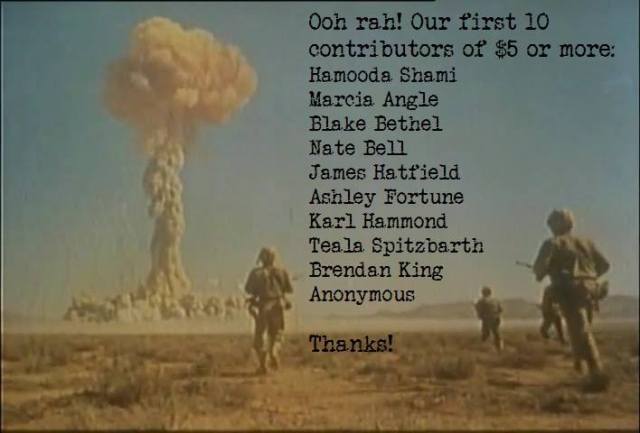
A movie trailer posted online includes interview snippets with Southern Utah historian and former Dixie State University President Douglas Alder and retired DSU professor Andrew Barnum, as well as dramatic archival footage of soldiers crossing the desert from their trenches toward a mushroom cloud billowing up over the desert.
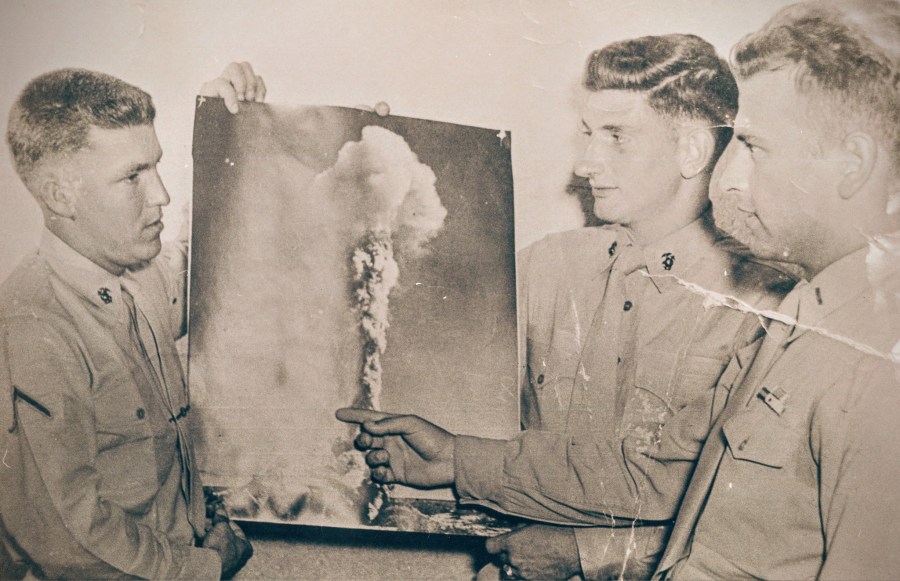
The primary focus of the approximately 15-minute clip will be the life and death of Marine Donald Guy, who was sent from Camp Lejeune, N.C., to the Nevada Test Sitefor what would be dubbed “Operation Upshot Knothole — Shot Badger” in 1953.
“Along with thousands of other Marines and soldiers, Donald was assured he was safe as he gazed at the billowing mushroom cloud and marched through the desert toward the atomic blast,” an overview of the film states. “Within only a few years, however, Donald began experiencing serious medical issues resulting from radiation exposure and soon became disabled. For the rest of his life, he fought for disability benefits with Veterans Affairs, but in 2009 he died before receiving his due compensation.”
North Carolina Central University Professor Craig Kabatchnick, a former Veterans Affairs attorney who founded the university’s Veterans Law Clinic in 2007, became interested in the plight of Guy and his widow and began assembling a film team in 2013 to tell the story of the Downwinder battles for compensation.
“He was repelled four times (by the shock wave),” Kabatchnick said last year. “They were guinea pigs. Everybody was.”
Kabatchnick claims the government applied artificially low standards for the Nevada test subjects when performing radiation dose reconstruction work to establish whether people were exposed to enough radiation to make them ill, something that continues to be disputed by officials, he said.
Bradley Bethel, the film’s producer, said Thursday that the crew decided to create a short documentary film and release it online, then try to pull together grant funding for a feature-length film that could enjoy wider distribution in theaters.
That would involve returning to St. George to add to the 12 interviews the crew initially filmed in 2014, he said.
“We think it’s a really powerful story focusing on the one veteran and his widow … and their fight for justice and compensation,” Bethel said. “There’s still plenty of material (the film crew) did get that we won’t be able to fit into the short. But you have to find your story and then stay focused on it.”
Bethel said the crowdfunding campaign will probably launch Friday and although the outlet has not been decided, he is hoping to use seedandspark.com, which fosters documentary filmmaking and provides additional package benefits based on the campaign’s success.
The crew is aiming for $10,000 to complete post-production but even if at least 500 people sign up for updates without contributing, that will be enough to help the film get marketing-related services that “would be a huge, huge help with spreading the word,” Bethel said.
If Seed and Spark doesn’t work for the campaign launch, the crew could move to website IndieGoGo, he said.
“Because the film is sponsored by the not-for-profit American Hero Legal Defense Fund, contributions are tax-deductible,” he added.
Bethel reaffirmed the crew’s hopes to debut the film at DSU’s DOCUTAH film festival. He said the online premiere is planned for Veterans Day in November, possibly on the popular website Short of the Week, after some additional film festivals in September and October.
“It’s been a cool process,” he said.
Follow Kevin Jenkins, @SpectrumJenkins. Call him at 435-674-6253.
‘Radioactive Veteran’ trailer
radioactiveveteran.com/
Utah documentary interviews
Douglas Alder: Former president of Dixie State University, historian
Lolly Seal: Daughter of Downwinder activist.
Daniel Miles: Historian, scientist, author of Radioactive Clouds of Death.
Bruce Church: Scientist for Atomic Energy Commission during testing.
Heber Jones: Schoolteacher in St. George during testing.
Andrew Barnum: Scientist at the Nevada Test Site.
Edward Liman: Utah historian.
Nancy Williams: St. George citizen, thyroid cancer patient.
Carl Wadsworth: Extra during John Wayne movie “The Conqueror” filmed at Harrisburg.
Tamra Begay: Dixie State student studying Downwinders.
Oh my goodness it has been a busy time. And because of that I must write briefly here about this fantastic trailer that you are likely to watch…and hopefully share with someone else..who will then share it with- you get the picture.
I met Mark Wampler a while back when he was putting out the feelers for a video editor to help him tell this very compelling story about vets who were exposed to nuclear weapons testing in the 1950’s.
Discussions took place, introductions were made, and a team came together over time and now this beauty of a trailer is newly minted and ready for the presses. FYI, I did not end up being the editor for this piece. I just sort of was a cheerleader on this project trying to help when I could with a bit here and there. It’s the kind of story though that got me excited in the first place about what film and video can do to make the world a more informed and better place.
The full movie will be forthcoming. But in the meantime, if you know any WWII vet or anyone dedicated to veteran’s rights, this is going to be a must see show.
I recently had a married couple (full disclosure: MY parents) approach me with the idea of creating a video for their 50th Wedding Anniversary using old printed photos that they have had in memory books for decades…5 decades! They wanted a short retrospective of sorts. And there were a lot of photos to go through.
It was a lot of fun walking down memory lane while perusing through so many images. How to cover the last 50 years in pictures? They have traveled widely, had two children, have two grandchildren…it’s been a full 50 years.
So we came up with the idea of starting the video at the beginning and an image of my mother’s parents, then starting on my parent’s actual wedding day.
My main concern in creating what ended up being an 8 minute long video was how to not get stuck in what most slideshow style retrospectives suffer from…they are boring as dirt to view. Sure the images themselves can conjure up memories and those are enjoyable, but whenever I think of slideshows I have seen at weddings or memorials they all really look the same in terms of photo orientation and so forth.
I feel like there is life in the photo that gets flattened. What is it like to hold a photo in your hands, vs looking at a flat 2D image on a screen?
With motion graphics we have created a way to give a sense of motion to a still image…so I first thought of just scanning in the images in a scanner and then working with them that way. Then I began comparing clarity of scans vs. camera capturing the images (taking pictures of the old pictures with a high quality camera). As I began to snap pictures, foregoing the lengthy and mixed results that can come with scanning, I bemoaned how un-alive the photos were going to look. They just looked better while held in a real person’s hand…like someone was just about to hand you the pic…like we used to before the digital age!
So, I turned my Nikon’s video mode on and just started filming as I went through the sequence of photos. I realized quickly that I was essentially doing what motion graphics are designed to do, but with actual motion instead of pretend motion. I like the feeling of seeing that a photo was and can be a handheld and intimate piece of time. And as always, there is a quality to printed photos that digital imagery will never be able to replicate. There is a warmth and precision there that feels alive.
I would LOVE to do more retrospectives from actual printed stills if anyone ever has a need for it. Anywhoo…here is the quick sample below.
I had no idea that Premiere Pro was being used for feature films such as Deadpool or Hail, Caesar. In this video the lead editors and makers of these movies discuss some pretty fascinating workflow situations and so forth. It’s about an hour long but really worth the watch. I definitely have some new ideas moving forward after pondering their discussion.
Recently I had the good fortune to run into a local hero of mine, who through a long and lovely conversation is now a new client. Her violin doubles as a fiddle. Her violin is a 1777 Vincenzo Panormo. Jen attended Julliard and she her Vincenzo have played shows from Carnegie Hall, to Peru and Turkey-and so many other places. I am not a huge violin guy. I love classic music but still…not really a violin guy. But to see Jen play is not like watching anyone else. There is something other worldly and unmistakably mysterious happening there. What I also love love love about Jen’s work with her music is that she isn’t playing within the boundaries of classical music that one would presume. She’s classically trained and has played in grand theatres…but she is equally at home playing on the floor of huts in 3rd world countries. She plays free local shows where she fiddles and jams with local musicians. One youtube video shows her fiddling while simultaneously hammering the kick drum on a set. She has participated in numerous humanitarian causes, using her violin to bring people together and create community. I could go on and on. But needless to say I am quite excited about generating some hopefully wonderful video for her upcoming performances and tours.
Recently TEDX contacted Jen for a shoot here in our area. The video, to me, is stunning. The lighting exquisite. The cuts and the flow that TEDX did on this piece are superb. I hope to one day be good enough to capture something as well as they did with my camera. But the music and the way Jen plays is the most amazing part. I have posted the full video here…and then below it my treatment of it to specifically advertise for a local show that she is doing. The full version below really is worth the watch.
I challenged myself to keep my edit down to 30 seconds, to try to have the text punctuated by the music and focus on using the open spaces so they fit naturally into the viewers field of view without interfering with the enjoyment of the brief glimpse of Jen’s craftwomanship. Here is my treatment…nothing too fancy but here it is…
Anyway…
Choosing a Thumbnail for Your Screenshot…and other text!
See that text above that is underneath the video I made and uploaded to Vimeo? What I learned is that the file name you give the file while saving on your hard drive is what will appear not only on Vimeo, but also in locations like…say…when you embed the video in a wordpress posting…or on FB. My original title read “JenVideoRev4”. And you know…that just doesn’t sound that as good or informational as “Jennifer Curtis Violin at Duke University 2/6/16”. So, I used the file name to double as informational content for viewers…especially since the video is marketing that performance piece specifically.
Pay attention to screen shot thumbnails. Vimeo allows you to choose any frame you wish to be what people see when the video is parked. So again…if you are making a video that is promoting a show or a location, you can “set up the shot” to help do passive marketing to show viewers-who may not even watch the video-information that may still use.
My screen shot for this says “The Road From Transylvania Home”…because that is the title or the umbrella that most of her work is under at this time, as she focuses on the work of Giorgio Enescu…a Romanian composer.
Different Platforms=Different Displays
On FB, the blue lettering is at the bottom of the screen though…but here on WordPress it embeds differently and the blue lettering is obscuring my efforts. Lack of standardization is something to ponder. Will more views come forth on Youtube, or FB, or Vimeo? When choosing a screenshot for parked video…if you have informational text, it’s worth pondering.
Quick Way to Change Embedded Video Screen Size On WordPress Blogs
When I embedded the codes from Youtube for video #1 and from Vimeo for video #2 they came with presets. Initially the Youtube video loaded in with presets at
width=”640″ height=”360″
My Vimeo vid was way smaller and didn’t want it to be. So, if you ever run into this…and you want your screen to be larger for the video just go into the HTML tab and find the width and height and change-o presto. Mind the aspect ratio. You can’t just make the numbers whatever you want. But if you are brand new to this…at least you now know that width=”640″ height=”360″ gets you a pretty nice size. When you click back to VISUAL it should be there in the new and improved size. Don’t forget to check the Preview tab to make sure all is well before publishing.
Running off to my day job now…but couldn’t resist posting my latest creation. I will write more on it later so if you are not following this blog already…well then now you have a reason to!
 The Video Slab